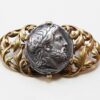


diamond and gold ‘Burgtheatre Ring’
A large 18 carat gold ring in the shape of a lotus flower, in the centre, is a brilliant cut diamond (app. 0.8 carats, H/I, VS1), one of the 9 so-called ‘Burgtheater Ringen’ made by A.E. Köchert for play writer Gerhart Hauptmann, Vienna, 1929.
weight: 29 grams
ring size: 20 mm. 10 1/4 US
The ‘Burgtheater’ is the Austrian National Theatre in Vienna and one of the most important German-language theatres in the world. The Burgtheater was created in 1741 by the Habsburg Empress Maria Theresa of Austria who wanted a theatre next to her palace. Her son, Emperor Joseph II called it the “German National Theatre” in 1776. It has become known as “die Burg” by the Viennese population; its theatre company of more or less regular members has created a traditional style and speech typical of Burgtheater performances. Three Mozart operas premiered there: Die Entführung aus dem Serail (1782), Le nozze di Figaro (1786) and Così fan tutte (1790). Beethoven’s 1st Symphony premiered there on 2 April 1800.
This ring is known as the ‘Burgtheater Ring’; The journalist Jakob Lippowitz (1865-1934), publisher of the Neues Wiener Journal (Concordia Press Club) and the writers association Concordia, annually awarded this ring between 1926 (150th jubilee) and 1934 for special merits either to a member of the Burgtheater or to a dramatist. In 1929 play writer Gerhart Hauptmann (1862 – 1946) received this beautiful gift for his contributions to the theatre.
Hauptmann was born in former Silesia (Poland). He was to learn agriculture but having no taste for country life, Hauptmann entered the art school intending to become a sculptor. He shortly lived in Rome and settled in Berlin where he soon gained a reputation as one of the chief representatives of modern drama and was one of the founders of German Naturalism (1880-1900). Hauptmann’s most famous pieces are ‘The Weavers’ (Die Weber) from 1892 and ‘The Rats’ (Die Ratten) from 1911. In 1912 Hauptmann received the Nobel prize for Literature “primarily in recognition of his fruitful, varied and outstanding production in the realm of dramatic art”. The Weavers was a play about the Industrial Revolution In Germany in the 1840s. It shows the weavers’ misery under extreme life circumstances. Strong dialogues and roles made the play very lifelike. Since Hauptmann wrote critical plays, he was very unpopular with Emperor, Wilhelm II, who initially forbid that the play be performed in German, after its premiere in the Breslau dialect had caused a lot of commotion. The Rats was a tragic comedy where people were portrayed as impulsive and suffering beings. In his play, Hauptmann portrays people as rats; always selfish in dark and dirty spaces.
Hauptman was a very productive writer, also writing poems, novels and for movies. Since 1902 his plays were performed regularly in the Burg theatre in Vienna and he also received a Ring of Honour from the city of Vienna in 1942.
| Period | Art Déco |
|---|---|
| Price | Sold |
Please find me a jewel like this